
Beyond the Ballot
Building K-12 bond programs that earn trust, control risk, and deliver for students
By Derek Bird, CCM
Director of Operations, Central Texas | AG|CM and Jason Burdine, K-12 Consultant
Executive Summary
School bond programs are among the most visible and consequential initiatives a K-12 district can undertake. They affect learning environments, taxpayer confidence, staff morale, community pride, and the district’s ability to keep its focus where it belongs: on students.
Yet too many districts enter the bond process too late, with too little outside support and too much pressure on internal teams. The result is predictable: unclear scopes, avoidable delays, preventable change orders, strained leadership capacity, and a community that wonders what is happening after it votes yes.
A stronger approach treats the bond as a long-range student-success strategy, not a last-minute construction list. Districts that plan early, invite the community in, communicate clearly, and bring owner-side expertise to the table are better positioned to protect public dollars and deliver on the promise made to voters.
THE CORE ARGUMENT
- Start planning one to two years before the election whenever possible.
- Tie every facility decision back to students, safety, access, or instructional outcomes.
- Use community engagement to shape scope, not just sell a proposal.
- Give the district dedicated owner-side representation from planning through closeout.
- Communicate after the vote as deliberately as before the vote.
“The bond should not be framed as a building program. It should be framed as a promise to students, staff, and taxpayers.”
The 75% Problem: Do Not Make the Superintendent the Project Manager
Bond programs can quickly become the loudest thing in the district. What begins as a facilities conversation can expand into planning meetings, contract reviews, scope decisions, pay applications, community questions, design revisions, and construction coordination.
For a superintendent, that is a dangerous gravity well. District leaders are hired to lead instruction, support educators, manage strategy, and keep the community focused on student success. When they are forced to become de facto project managers, the mission gets crowded out.
The issue is not capability. School leaders are capable. The issue is capacity and specialization. Construction procurement, cost controls, sequencing, and field verification are full-time disciplines. Expecting existing teams to absorb that work while continuing to run the district is how good people get buried under work they should not have to own alone.
“If the district does not assign the work, the work assigns itself — usually to the superintendent.”
Start the Runway Earlier Than Feels Necessary
A bond program should not begin six months before an election. In today’s environment, districts need a one- to two-year runway to evaluate facility conditions, test enrollment assumptions, align educational specifications, shape scope, brief the board, and prepare the community.
That runway matters even more in Texas, where transparency expectations and bond requirements continue to evolve. Districts need clean documentation, defensible planning, and a clear explanation of how proposed projects connect to long-range needs.
Fast-growth districts may not have the luxury of perfect timing. Students arrive, subdivisions fill, and capacity pressure becomes immediate. But even when the timeline is compressed, the discipline remains the same: define the need, document the why, and bring the right expertise in early.
“The more runway a district gives itself, the less likely it is to confuse urgency with readiness.”
Build Community Trust Before You Ask for Community Funding
The public vote is not the beginning of the trust-building process. It is the test of whether that process has already worked.
Districts build credibility by inviting community members into the work early. Advisory committees, campus tours, listening sessions, staff conversations, and business community engagement all help residents see the needs for themselves. Just as important, they give the district a chance to hear what the community values before the final scope hardens.
This is where better engagement can create a better program. A district may begin with one set of assumptions, only to discover that the community sees a different priority or a smarter way to sequence the work. Done well, engagement is not theater. It is planning intelligence.
“Community trust is built before the ballot, not after the vote count.” |
Put the Skeptics in the Room
Every bond program has skeptics. Leaving them outside the process does not neutralize them. It usually gives misinformation more oxygen.
Districts should intentionally include critics, vocal taxpayers, business owners, parents, staff, and community members who may not begin as supporters. Some will remain opposed. Some will become less vocal once they see the facts. A few may identify real blind spots that improve the plan.
This is not about manufacturing consensus. It is about building a process that is honest enough to withstand scrutiny. Sometimes a perceived naysayer is simply someone who has not been heard. Sometimes they are partly right. Either way, the district is better off knowing that early.
“A strong bond process does not avoid hard questions. It invites them early enough to matter.” |
Make Every Project a Student Outcome Story
The most persuasive bond programs are not about buildings. They are about what buildings make possible.
A safer entry sequence is a student safety story. A modern CTE lab is a workforce readiness story. A cafeteria renovation can become a student experience and program expansion story. A roof replacement is a continuity-of-learning story. HVAC improvements are health, comfort, and instructional time stories.
When districts connect needs and wants to student achievement, they give the community a clearer lens for evaluating the investment. The question becomes less “Do we want a new facility?” and more “What do students, teachers, and the community need this facility to do?”
“A school bond is not a construction campaign. It is a student-success strategy with a construction component.” |
Give the District Someone Who Is Clearly on Its Side
Architects, engineers, contractors, subcontractors, financial advisors, and attorneys all play essential roles in a bond program. But none of those roles replaces the need for an owner’s representative who is focused on the district’s interests from planning through closeout.
An effective owner’s representative helps the district define scope, evaluate constructability, support procurement, review contracts, manage budgets, monitor schedules, verify work in place, and protect the owner’s position when questions arise.
That advocacy matters because the district is ultimately accountable to taxpayers. The owner’s representative helps translate technical complexity into clear decisions, flags risks before they become headlines, and gives leadership a trusted advisor who can say, plainly, when a direction is not in the district’s best interest.
“The owner’s representative is the person in the room whose job is to protect the owner’s promise.” |
Control Costs Before They Become Headlines
Cost control starts before construction. It begins with realistic budgets, clear scopes, thoughtful contracts, disciplined contingencies, and a sharp understanding of when estimates were created versus when work will actually be bought and built.
A district may begin planning a year before an election, spend another year in design, and enter construction two or more years after the earliest budget was drafted. Pricing today’s scope in today’s dollars is how tomorrow’s shortfall gets born.
Owner-side review also matters during construction. Pay applications can include dozens of subcontractor line items. The district needs someone who can compare billings to actual work in place, reconcile subcontractor charges, and catch issues before funds are released.
“Cost control is not one big move. It is a thousand small decisions made before the district loses leverage.” |
Keep Talking After the Vote
Once a bond passes, the community expects movement. But major projects do not move from election night to shovels in the ground overnight. Design, permitting, procurement, pricing, and sequencing take time.
Without steady communication, that necessary gap can look like inaction. Districts should explain what is happening behind the scenes and share progress through board updates, district websites, social media, parent platforms, email, community meetings, and project dashboards.
The goal is not to overwhelm people with construction jargon. The goal is to make progress visible, explain delays before they become rumors, and show the community that the district is doing what it said it would do.
“Transparency is not a dashboard. It is a discipline.” |
Plan for the Enrollment Reality You Actually Have
Not every district is building for growth. Some communities are facing declining enrollment, aging populations, shifting housing patterns, or facilities that no longer match how students are distributed across the district.
That changes the bond conversation. The need may not be a new campus. It may be modernization, consolidation, safety upgrades, major maintenance, or better use of existing public assets.
In these cases, long-range planning becomes even more important. Districts may need to coordinate with municipalities on land use, transportation, emergency response, facility sharing, technology, and community services. The opportunity is bigger than a school project: it is a chance to align public investment around the future of the whole community.
“Declining enrollment does not eliminate facility needs. It raises the bar for smarter public planning.” |
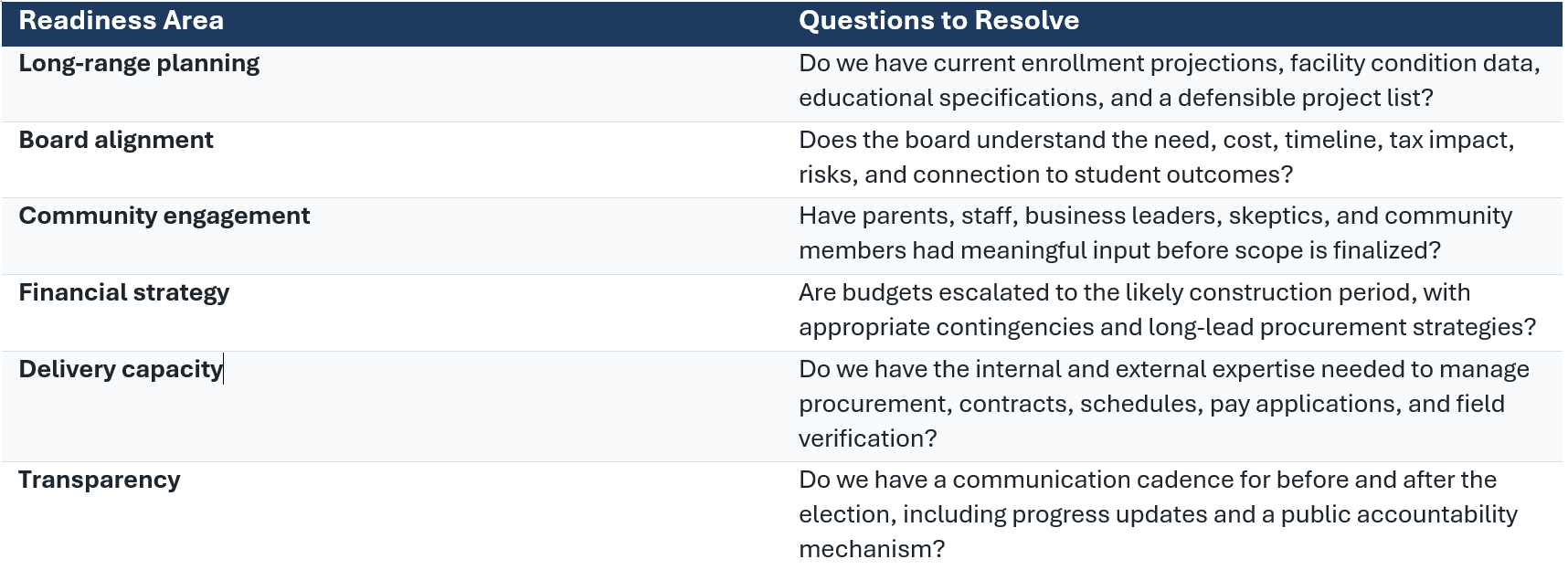
Bond Readiness Checklist
Before a district asks voters to approve a bond, leadership should be able to answer these questions with confidence.
The Bottom Line: Build the Plan Before the Vote
A successful bond program is not won on election day. It is earned through the months of planning, listening, alignment, and communication that come before the ballot — and proven through the disciplined execution that follows.
Districts that begin early, invite real input, communicate transparently, and protect the owner’s interests are better positioned to deliver projects that communities can trust and students can feel. The outcome is not simply a completed building. It is a safer, stronger, more functional learning environment — and a district that kept its promise.
“The real measure of a bond program is not whether the building opens. It is whether the district kept faith with the community that funded it.” |
About the Authors
Derek Bird, CCM, is Director of Operations for Central Texas at AG|CM and brings 20+ years of construction industry experience to K–12 bond planning and project delivery. He has extensive experience supporting Texas school districts on major bond programs, including work with Wimberley ISD, La Vernia ISD, Natalia ISD, Navarro ISD, Schertz-Cibolo-Universal City ISD, Uvalde CISD, and others. With a background spanning new campuses, renovations, CTE, athletics, and districtwide improvements, Derek offers a practical perspective on how districts can move from bond vision to successful execution.
Jason Burdine is a Texas-based education leader and Texas A&M graduate with extensive experience in school governance and K–12 initiatives. A former Fort Bend ISD trustee, gubernatorial appointee to the Texas School Safety Center, and TEA-authorized board trainer, he now supports AG|CM’s K–12 business development efforts across Texas.
About AG|CM
AG|CM supports public entities and school districts with owner’s representation, program management, project controls, and construction expertise. By serving as an advocate for the owner, AG|CM helps districts plan, procure, manage, and deliver complex bond programs with greater clarity, accountability, and confidence.